Basic signal types#
In this section, we will briefly introduce a few basic signal types that are commonly used in conceptual ocean acoustics discussions.
Sine Wave#
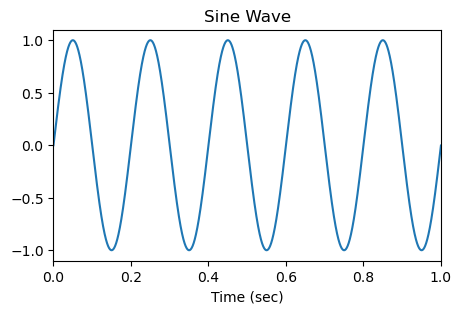
A sine wave is a signal with constant amplitude and frequency that can be described by:
\(y(t) = A \sin(2 \pi f t + \mathcal{\phi)}\),
where:
\(A\) - peak of the deviation of the function from zero
\(f\) - the number of oscillations occurring within a second
\(\phi\) - where in the cycle the wave is at zero (in radians)
Chirp#
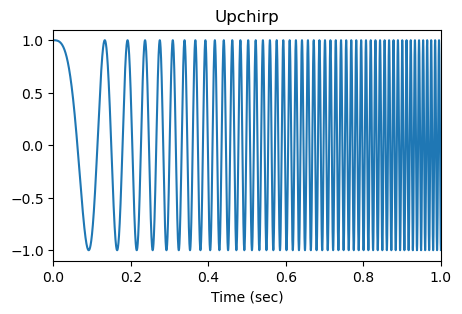
Another example of a signal is a chirp, or a signal with an increasing or decreasing frequency.
We will generate example with linearly increasing frequency from 1Hz to 10Hz.
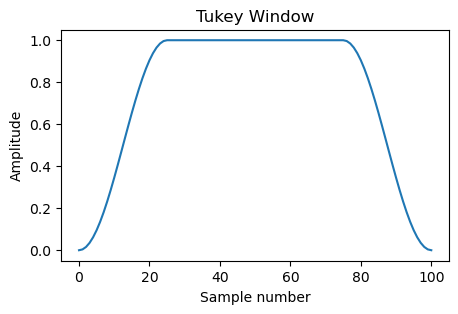
Often when we want to transmit a chirp, we would taper the beginning and end of the signal, so that signal plays nicely with the physical turing on and off the transducer.
We can achieve this by “windowing” a signal. The same technique is also often used to “cut out” part of a long signal.
There are many different window functions (see here for a list in scipy). In the example below, we generate a Tukey window and use it to taper a chirp.

Impulse#
